Here’s something you probably know but don’t often say out loud: most people don’t really know their neighbors.
They wave. Maybe they exchange names. But actual conversations, actual connection — that’s rare. And that’s a shame, because the research on neighborhood relationships is clear: people who know their neighbors are happier, feel safer, and are more likely to get and give help when they need it.
A block party fixes this.
One afternoon of shared food, lawn games, and genuine mingling can change the dynamic on an entire street. I’ve seen neighborhoods that went from strangers-who-wave to friends-who-check-on-each-other after a single well-planned block party.
Here’s how to plan one.
Do You Need a Permit?
Yes, in most cities, you do.
If you’re closing a street or blocking traffic (even temporarily), you typically need a block party permit from your city or municipality. The good news: these are usually inexpensive ($10-50), processed quickly, and cities are enthusiastic about approving them.
How to get one:
Search “[your city] block party permit” for the local process. Most cities have an online form. You’ll need to specify the date, the street section you want to close, your estimated attendance, and sometimes your plan for trash and recycling.
Alternatives if you can’t close the street:
- Use a private driveway, cul-de-sac, or parking lot
- Block off a section of the sidewalk or grass area (no street permit needed)
- Use a nearby park pavilion (many allow free reservations for neighborhood events)
Building the Organizing Committee
Don’t try to plan this alone. A block party is a community event — bring the community in from the start.
Who to recruit: – Two or three neighbors who are already connected to the street’s social fabric – At least one person who knows the neighbors on each “side” of the street – One person who’s good at logistics – One person who knows everyone’s dietary restrictions and family situations
Send a short email or drop a note in mailboxes: “I’m thinking about organizing a block party this summer — want to help plan it?” You’ll be surprised who says yes.
Having three or four people involved from the start distributes the work and naturally expands the invite list. People invite their own friends and the party grows organically.
Setting the Date
Best months for a block party: June, July, or August. Peak summer. Weather is most reliable.
Best days: Saturday is the standard. Sunday works too. Avoid major holiday weekends when people tend to travel.
Best timing: Noon to 4 PM or 1 PM to 6 PM. This captures the prime afternoon without running too late for families with young kids. If you want it to go into the evening, push the start to 3 PM.
Poll the neighborhood first: Before committing to a date, send around a quick survey of two or three options. Use a free tool or just knock on doors. Choosing a date that works for the most connected households is more important than choosing the “ideal” day on paper.
The Invite Strategy
A block party invite needs to be personal, not just posted on a flyer.
What works: – Knock on every door on the block personally. This is the most important step. It signals real effort and gives you a chance to gauge who’s excited and who might help. – Follow up the in-person visit with a printed flyer in every mailbox with the date, time, and RSVP info – For larger neighborhoods, use a Mixily event page to send a link digitally — neighbors can RSVP, see who’s coming, and get updates without needing your phone number
On the flyer or event page, include: – Date, start and end time – Location (street section or exact spot) – What to bring (a side dish, a chair, a lawn game) – Who to contact with questions – An RSVP or headcount request (so food planning is easier)
Also ask neighbors to spread the word further. The neighbor who knows the family three houses down better than you do is your best ambassador.
Food and Drink Logistics
The community potluck approach is the natural fit for a block party. Residents contribute side dishes, desserts, and non-alcoholic drinks. The organizing committee handles the main event (grill, tables, supplies).
The organizing committee handles: – The grill and proteins (burgers, hot dogs, veggie options) – Tables and folding chairs (or a rental if needed) – Paper plates, napkins, utensils – Trash and recycling stations – Lemonade or water station
Assign dishes to neighbors: – Ask each household to bring one item based on their family size – Assign by category: salads, side dishes, desserts, drinks – Keep a list on your event page or in a shared document
See our potluck planning guide for how to coordinate dish assignments without ending up with six potato salads.
Activities for All Ages
The best block parties have something for every age group.
For kids: – Bounce house rental (a hit, requires advance booking) – Water balloon toss – Three-legged race and classic field games – Sidewalk chalk station – Bubbles and outdoor toys for the youngest kids
For adults: – Cornhole with a bracket setup – Bocce ball – Horseshoes – Lawn Jenga – A local music act or a great playlist on outdoor speakers
For older residents: – A comfortable seating area away from the main activity zones – Easy access to food and drinks without navigating through crowds – Quieter conversations — the organized activities help, but so does intentional seating design
For everyone: – A neighborhood trivia game (questions about the street’s history, local landmarks, funny facts about neighbors who’ve consented to share) – A photo display of neighborhood history if any long-term residents have old photos
For more outdoor party activity ideas, see our outdoor party planning guide.
Setting Up the Space
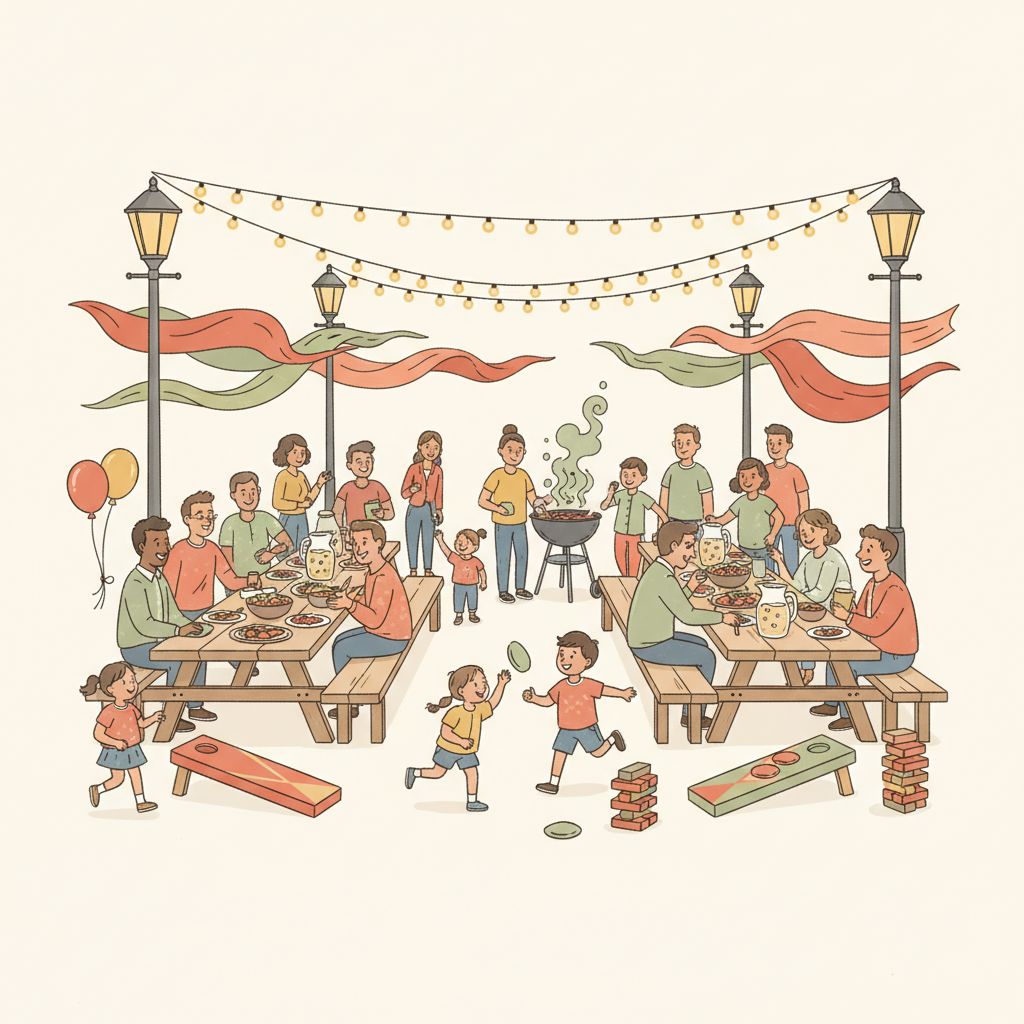
A block party needs clear zones to function well.
Arrival zone: A welcome table with name tags (surprisingly helpful for people who aren’t sure of names) and a sign with the schedule or activity rundown.
Food zone: Tables in a row or U-shape. Keep the grill separate from the food tables but in view.
Activity zone: Lawn games and kids’ activities positioned away from the main eating area to prevent traffic congestion.
Seating zone: A mix of folding tables and chairs for families and groups. Position some seating in shade.
Stage area (if you have music): Set up sound in a way that it fills the space without overpowering conversation at the eating tables.
Building in a Moment of Connection
The best block parties don’t just feed people — they create a real neighborhood moment.
A few ideas:
Neighbor introductions: Halfway through the afternoon, have someone with a microphone or big voice do a round of informal introductions. “Who’s been on the block the longest? Who moved here most recently? Any kids celebrating a birthday this week?” These prompts create brief moments of visibility that help people connect.
A neighborhood wish jar: Put out a jar with cards that say “One thing I love about this neighborhood is ___.” Post the responses on a community board after the party (or in the next block party newsletter).
A group photo: Gather everyone for a group photo at a specific time. Post it in a shared place. It becomes a record of the community and people love having it.
Making It Annual
The first block party is the hardest. The second one is easy.
Once you’ve done it once, you have a template. You know who helps, what food works, where the tables go. You also have a community expectation — people will start asking about next year before this year’s event is over.
Create a simple email list or shared contact list at this year’s party. That list becomes the backbone for every future event.
The long game here is building community that lasts beyond a single afternoon. A neighborhood that gathers once a year becomes a neighborhood that looks out for each other year-round.
Ready to send your block party invites? Mixily makes it easy to create a free event page — invite the whole block, collect RSVPs, share details and updates, and know your headcount before you buy food. Free, fast, and no app required for guests.
Related reading: housewarming party ideas