
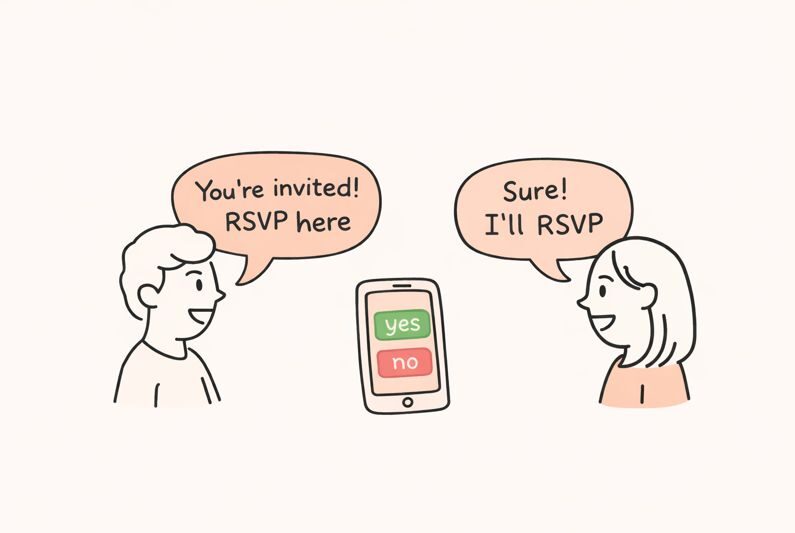
An RSVP is more than just a response to an invitation. It’s a small social contract between hosts and guests that makes events possible. When guests respond promptly, hosts can plan effectively. When hosts communicate clearly, guests can make informed decisions.
Yet somehow, RSVP etiquette has become one of the most commonly broken social norms. Guests forget to respond. Hosts send vague invitations. Plus-ones show up uninvited. Last-minute cancellations throw everything off.
This guide covers the essential rules of RSVP etiquette for both hosts and guests, plus how to handle those awkward situations that inevitably arise.
How to RSVP
If you’ve received an invitation and aren’t sure what to do next, here’s the simplest breakdown. RSVPing well comes down to four steps.
Step 1: Read the invitation carefully. Check the date, time, location, and any special instructions. Look for whether plus-ones are included and if there’s a dress code. If the host took time to write a clear invite (bonus points if they followed an invitation wording guide), the least you can do is read it thoroughly.
Step 2: Decide if you can attend. Check your calendar right away. Don’t put it off. The longer you wait, the more likely you’ll forget entirely.
Step 3: Respond using the method the host specified. If they sent a digital invite with an RSVP button, use it. If they asked for a text, send a text. If they’re using online RSVP tools, click the link and respond there. Don’t make the host track you down through a different channel.
Step 4: Respond by the deadline. This is non-negotiable. Hosts set deadlines because they need to finalize headcounts, catering, seating, and supplies. Responding on time is one of the easiest ways to be a great guest.
RSVP Etiquette for Hosts
As a host, your job is to make responding easy and set clear expectations.
Give Guests Enough Notice
How far in advance you send invitations depends on the type of event:
- Casual gatherings (dinner parties, BBQs, game nights): 3-4 weeks
- Birthday parties and showers: 4-6 weeks
- Formal events (weddings, galas, milestone celebrations): 6-8 weeks
- Holiday parties: 4-6 weeks (earlier during busy seasons)
Sending invitations too late puts guests in an awkward position if they’ve already made other plans.
Include All Necessary Information
A proper invitation should answer every question a guest might have:
- What: Type of event (birthday dinner, cocktail party, etc.)
- When: Date, start time, and end time if applicable
- Where: Full address with any parking or access instructions
- Who: Is this invite for them only, or can they bring a guest?
- What to wear: Dress code if relevant
- What to bring: Gifts, food contributions, or nothing at all
- RSVP deadline: A specific date, not “soon”
The clearer your invitation, the easier it is for guests to respond. Need help with the wording? Check out our invitation wording guide for templates you can copy.
Make RSVPing Easy
The harder you make it to respond, the fewer responses you’ll get.
Good RSVP options:
- One-click response via email or app
- Reply to this text
- Simple online form with minimal questions
Avoid:
- Requiring guests to create accounts
- Asking too many questions upfront
- Providing only a phone number (many people hate calling)
Want to get more people to RSVP? Make the process as frictionless as possible. A free RSVP website can handle everything for you.
Be Gracious with Follow-Ups
When guests don’t respond by your deadline, a gentle reminder is appropriate. One or two follow-ups is fine. More than that becomes pushy.
Good reminder: “Hi! Just a friendly reminder to RSVP for the party by Friday. No pressure either way – just need to finalize the headcount.”
Avoid:
- Guilt-tripping guests
- Sending multiple reminders in a short period
- Making guests feel bad for being slow to respond
Handle “Maybes” Appropriately
Some guests genuinely don’t know if they can attend. How you handle this depends on your event:
- For casual events: Accept maybes and follow up closer to the date
- For catered events: Ask for a firm answer by a secondary deadline
- For limited capacity: Explain that you need a definite yes or no
It’s okay to say: “I totally understand you’re not sure yet. Can you let me know by [date]? I need to give the caterer final numbers.”
RSVP Etiquette for Guests
As a guest, your main job is simple: respond, and respond on time.
Always Respond
This is the most fundamental rule of RSVP etiquette: always respond to invitations, whether your answer is yes, no, or maybe.
Not responding is never acceptable. Even if you can’t attend, a quick “I’m so sorry, I won’t be able to make it” is infinitely better than silence.
Respond by the Deadline
The deadline exists for a reason. Hosts need to confirm catering, seating, supplies, and logistics. Responding late creates real problems.
If you can’t meet the deadline:
- Respond with what you know (“I’m 90% sure I can come, but confirming Friday”)
- Let the host know you’re working on it
- Commit to a date when you’ll have an answer
Don’t Bring Uninvited Guests
Unless the invitation explicitly says “plus one” or “[Your Name] and Guest,” assume you’re invited solo.
If you want to bring someone:
- Ask the host directly before RSVPing
- Accept “no” gracefully – there may be budget or space constraints
- Never just show up with an extra person
If You Said Yes, Show Up
Your RSVP is a commitment. When you say yes, the host is counting on you. They’ve ordered food for you, made seating arrangements for you, and may have limited their guest list based on your response.
Bailing last-minute should be reserved for genuine emergencies, not “I’m tired” or “something better came up.”
If Plans Change, Communicate Early
Life happens. Sometimes you genuinely can’t attend an event you committed to.
The right way to cancel:
- Notify the host as soon as possible
- Apologize sincerely
- Be honest but brief about the reason
- Offer to connect another time if appropriate
Examples:
- “I’m so sorry, but I came down with a cold and don’t want to get everyone sick. I hope you have an amazing party!”
- “Something came up with work and I won’t be able to make it. I’m really disappointed to miss it.”
RSVP Response Examples
Not sure exactly what to say? Here are ready-to-copy RSVP responses for every situation.
Accepting (Formal)
Email: “Dear [Host], Thank you so much for the invitation to [event]. I would be delighted to attend and look forward to the evening. Please let me know if there is anything I can bring. Warm regards, [Your Name]”
Text: “Hi [Host], thank you for the kind invitation. I’m happy to confirm I’ll be attending on [date]. Looking forward to it!”
Accepting (Casual)
Email: “Hey [Host]! Count me in for [event]. Can’t wait! Let me know if you need me to bring anything.”
Text: “Yes! I’ll be there. So excited. Need me to bring anything?”
Declining (Formal)
Email: “Dear [Host], Thank you for thinking of me. Unfortunately, I have a prior commitment on that date and won’t be able to attend. I hope the event is wonderful, and I’d love to celebrate with you another time. Best wishes, [Your Name]”
Text: “Hi [Host], thank you so much for the invitation. I’m sorry to say I won’t be able to make it due to a scheduling conflict. I hope it’s a great event!”
Declining (Casual)
Email/Text: “Ugh, I wish I could make it but I’ve got plans that night. Have the best time and take pics for me!”
Maybe / Tentative
Email/Text: “Thanks for the invite! I’m not 100% sure about my schedule that day yet. Would it be okay if I let you know by [date]? I really want to come if I can make it work.”
Whatever your answer, the important thing is to respond. A quick “no” is always better than leaving the host guessing.
How to Handle Awkward RSVP Situations
Even with the best intentions, tricky situations arise.
What If Someone Doesn’t RSVP?
For hosts:
- Send a friendly reminder before the deadline
- After the deadline, reach out personally to important guests
- For planning purposes, assume non-responders aren’t coming
- Don’t hold grudges – some people are just forgetful
Appropriate follow-up: “Hey! I didn’t hear back about the party on Saturday. Totally fine either way, but I’m finalizing food orders tomorrow. Any chance you know if you can make it?”
If you’re a host struggling with non-responses, read our guide on how to get more people to RSVP.
What If Someone Cancels Last Minute?
For hosts:
- Accept it graciously (even if you’re frustrated)
- Don’t guilt-trip them – you don’t know their situation
- Adjust your plans as needed
- Consider whether this is a pattern worth addressing privately
For guests:
- Apologize sincerely
- Keep explanations brief
- Offer to make it up to them if appropriate
- Don’t make it a habit
What If Someone Brings Extra Guests?
For hosts:
- Stay gracious in the moment – address it privately later if needed
- Accommodate them if possible
- For recurring offenders, be explicit in future invitations: “Unfortunately, we can’t accommodate additional guests this time”
For guests who accidentally brought someone:
- Apologize immediately and privately
- Offer to leave if space/food is truly limited
- Never do it again
What If You Need to Change Your RSVP?
Changing from yes to no:
- Only do this for genuine reasons
- Notify the host immediately
- Apologize sincerely
- Don’t make excuses – be honest and brief
Changing from no to yes:
- Contact the host to ask if there’s still room
- Don’t assume you can still come
- Accept gracefully if they say no (they may have filled your spot)
RSVP Etiquette for Specific Events
Different events come with different expectations. Here’s what you need to know for the most common ones.
Baby Shower RSVP Etiquette
Baby showers are usually organized by a friend or family member, not the parent-to-be. That means you should RSVP to the host listed on the invitation, not directly to the mom or dad.
The typical RSVP deadline for a baby shower is about 2 weeks before the event. When you respond, let the host know if you’re attending and whether you plan to bring a gift from the registry or something else.
For virtual baby showers, the same rules apply. RSVP through whatever link or method the host provides, and show up on time just as you would in person. If you can’t attend, a quick decline is still better than ghosting.
Wedding and Bridal Shower RSVP Etiquette
Weddings and bridal showers have the highest stakes when it comes to RSVPs. Every seat costs money, and caterers need exact numbers.
Respond within 24-48 hours of receiving the invitation if you can. Always respond, even if you’re declining. Fill out response cards completely, including the number of guests attending and any meal preferences.
For bridal showers, the RSVP deadline is typically 2 weeks before the event. For weddings, expect the deadline to be 3-4 weeks before. These longer lead times exist because venues and caterers require final headcounts well in advance.
If you receive a wedding invitation with a physical RSVP card, mail it back. Don’t text the couple instead, even if you know them well.
How to RSVP No (Politely Declining)
Yes, you should absolutely RSVP even when your answer is no. Hosts need to know who’s not coming just as much as who is. A quick decline helps them plan accurately and possibly invite someone else.
Here are three decline messages you can copy and send right now:
Formal: “Thank you so much for the invitation. Unfortunately I won’t be able to attend, but I hope you have a wonderful event.”
Casual: “I wish I could be there but I can’t make it this time. Have an amazing time!”
Last-minute: “I’m so sorry for the late notice, but something came up and I won’t be able to make it tonight. I’m really sorry to miss it.”
Remember: a quick “no” is always better than no response at all. The host will appreciate your honesty far more than your silence.
Plus-One Etiquette
Plus-ones are one of the most commonly misunderstood aspects of RSVP etiquette.
For Hosts
Be crystal clear about who’s invited:
- “John Smith and Guest” = plus-one is welcome
- “John Smith” only = no plus-one
- “The Smith Family” = entire household is welcome
If you can’t accommodate plus-ones, it’s okay to say so. Budget and space constraints are real.
For Guests
If your invitation includes a plus-one:
- You’re not obligated to bring someone
- Let the host know either way when you RSVP
- Your plus-one should be someone appropriate for the event
If your invitation doesn’t mention a plus-one:
- Don’t assume you can bring someone
- If you want to ask, do so politely and early
- Accept “no” without argument
How to ask: “I’d love to come to your party! I wanted to check – would it be okay if I brought my partner? Totally understand if not.”
Modern RSVP Etiquette Updates
The rules of RSVP etiquette have evolved with technology.
What Does RSVP Mean on an Invitation?
RSVP stands for “Respondez s’il vous plait”, which is French for “please respond.” When you see RSVP on any invitation, whether it’s a printed card, an email, or a digital invite, it means the host is asking you to let them know whether you’ll attend.
On a physical card, you’ll usually find a separate response card to mail back. On digital invitations, there’s typically a button or link to click. Either way, the meaning is the same: the host needs your answer so they can plan properly.
Seeing RSVP on an invitation is not optional or decorative. It’s a direct request. Respond yes, no, or maybe, but always respond.
Digital vs. Paper Responses
- Responding digitally is completely acceptable for most events
- Match the formality of your response to the invitation
- For formal events with paper invitations, a mailed response card is still preferred
Responding via Text
- Acceptable for casual events among friends
- Keep it clear: “Hey! Yes, I’ll be there Saturday. Thanks for the invite!”
- Not appropriate for formal events
Social Media Event Responses
- “Interested” is not an RSVP – it’s essentially a maybe
- If you’re attending, mark “Going” AND confirm directly with the host
- For private events, respond through the actual invitation, not Facebook
The “Maybe” Response
- Use sparingly and only when genuinely uncertain
- Always follow up with a definitive answer before the deadline
- Don’t use “maybe” as a soft “no”
The Golden Rule of RSVP Etiquette
Whether you’re hosting or attending, the core principle is simple: respect other people’s time and effort.
Hosts spend time and money creating events. Guests have busy lives and limited availability. Good RSVP etiquette acknowledges both realities and keeps communication clear, kind, and timely.
Make RSVPs Effortless
Good etiquette starts with good tools. Create your free event on Mixily and give your guests an easy, ad-free way to respond. With automatic reminders and simple tracking, you’ll spend less time chasing RSVPs and more time enjoying your event.
Questions about RSVP etiquette for your specific situation? Email us and we’ll help you navigate it.
Want to dive deeper? Check out How to Build Community in a Small Town for more expert advice.
Frequently Asked Questions
What does RSVP mean?
RSVP stands for “Répondez s’il vous plaît” — French for “Please respond.” It’s a request from the host for guests to confirm whether or not they’ll attend an event. Without RSVPs, hosts can’t finalize headcounts, food, or seating.
How long do you have to RSVP?
Respond as soon as you know whether you can attend — ideally within 24–48 hours of receiving the invitation. Always respond by the host’s stated deadline, not on it. The sooner you reply, the easier it is for the host to plan.
What do you say when you RSVP to a party?
Keep it simple: confirm your name and whether you’ll be attending. Include the names of any additional guests if you’re bringing a plus-one. Something like “Hi Sarah, I’ll be there — just me!” is perfectly sufficient. A warm tone is always appreciated but not required.
Is it rude not to RSVP?
Yes. Not responding forces the host to follow up individually and prevents them from finalizing headcounts, catering orders, and seating arrangements. Always respond, even if the answer is no — a quick “Sorry, I can’t make it!” is far better than silence.