
A hybrid event combines a live in-person gathering with a simultaneous virtual component, letting attendees choose how they participate. The format went mainstream during 2020, but it didn’t fade when restrictions lifted. According to the Amex GBT 2026 Global Meetings & Events Forecast, 68% of event professionals now include hybrid or virtual events in their programs, and Cvent’s 2026 Planner Sourcing Report lists hybrid frequency as a top trend for the year. It’s not a workaround anymore. It’s a permanent format.
Key Takeaways
– 68% of event professionals now run hybrid or virtual events (Amex GBT, 2026)
– Hybrid lets you tier tickets: in-person becomes VIP, virtual becomes general admission
– You don’t need to stream in-person content — the virtual experience can be its own thing
– The biggest mistake is treating both audiences as one; design each experience separately
What Is a Hybrid Event?
A hybrid event runs two experiences at the same time: one group attends in person, another joins online. The two don’t have to be identical. In fact, the best hybrid events are intentionally different — the in-person experience focuses on atmosphere, connection, and sensory details, while the virtual experience centers on content, accessibility, and convenience.
Think of it less as “the same event, but some people are on Zoom” and more as two complementary products under one roof. The organizer produces both. The audience self-selects based on what works for them.

5 Benefits of Hosting Hybrid Events
Hybrid events aren’t right for every occasion, but when the format fits, the advantages compound quickly. Here’s what organizers consistently report.
1. Reach audiences across cities and time zones. In-person events are capped by venue size and geography. Add a virtual component and you can reach people who would never travel but genuinely want to participate. This is especially valuable for communities spread across multiple cities.
2. Design richer experiences for both groups. In-person attendees get the full sensory experience — the room, the energy, the chance to meet people face to face. Virtual attendees can get something different: exclusive content, interactive worksheets, or a more intimate Q&A format that’s harder to pull off in a big room. Neither has to feel like a consolation prize.
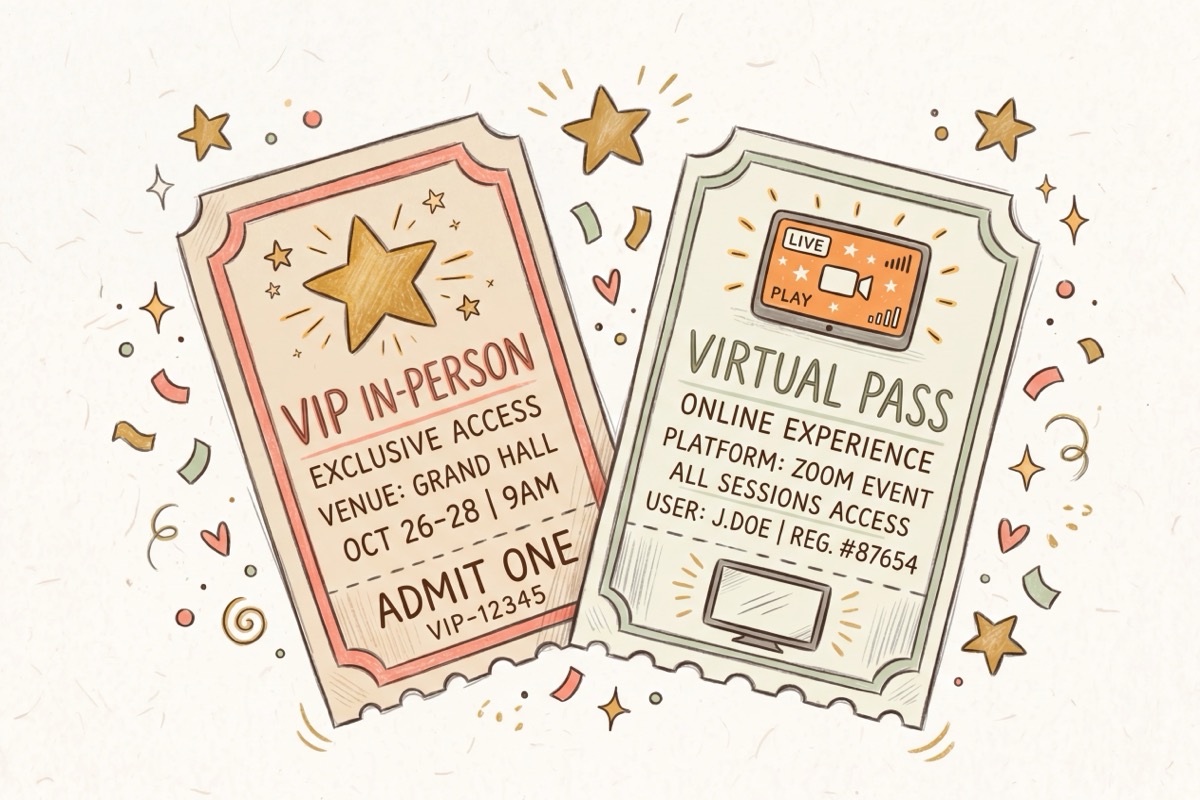
3. Offer tiered ticketing. The in-person ticket becomes the VIP pass. The virtual ticket is general admission. This gives you a wider price range to work with and opens your event to people who want to participate but can’t justify the cost or logistics of traveling.
4. Repurpose and resell the content. When you record the virtual component, you don’t just have a livestream — you have a content asset. Workshops, talks, and demonstrations can be packaged and sold as on-demand access after the event ends. That’s a revenue stream that purely in-person events never had.
5. Increase overall earning potential. More attendees plus a resale content strategy adds up. You’re no longer limited by how many seats fit in a room. Some organizers find the virtual revenue eventually rivals or exceeds their in-person ticket sales.
According to Markletic research across 3,000+ organizers, 86% of B2B organizations report positive ROI from hybrid events within seven months — faster than most other event formats.
How to Plan a Hybrid Event (Step by Step)
Running a hybrid event means producing two events simultaneously. That sounds daunting, but breaking it into three distinct planning tracks makes it manageable. Here’s the framework.
1. Design the In-Person Component
Start with your in-person event as if the virtual component didn’t exist. What’s the venue? What’s the program? How many people can attend comfortably? What’s the vibe you want in the room?
Think about what makes in-person worth it for your audience. The best in-person experiences offer things you genuinely can’t replicate online: the energy of a crowd, food and drink, spontaneous conversations, physical demonstrations. Lean into those. Don’t try to design an in-person event that also happens to look good on camera — design it for the people in the room first.
If you’re running a recurring event, consider creating a VIP tier for returning attendees. Higher-cost in-person tickets with early access, a reserved area, or exclusive programming can justify a premium price point without adding much complexity.
2. Plan the Virtual Experience
Here’s where most first-time hybrid organizers go wrong: they point a camera at the in-person event and call it virtual content. That rarely works. What’s engaging to someone in the room often doesn’t translate to a screen — especially if the audio is spotty and the camera angle is bad.
Instead, design a distinct virtual experience. Ask yourself: what can I offer remote attendees that’s worth their time and money? Some options that work well:
- An exclusive pre-event session with the speaker or host, available only to virtual ticket holders
- A downloadable worksheet or resource tied to the event content
- A structured Q&A format where virtual attendees can submit questions in advance
- A virtual “green room” where online attendees can connect with each other before or after
The goal is to make the virtual ticket feel like its own product, not a livestream of something happening elsewhere.
3. Choose Your Ticketing and Livestream Platform
You need two things: a way to sell different ticket types (in-person vs. virtual) and a way to deliver the virtual experience securely.
For ticketing, look for a platform that lets you create multiple ticket types under one event page. This way you can send a single link to your audience and let them choose how they want to attend. Sending different links to different groups gets messy fast.
For delivery, avoid sending attendees to a generic Zoom link or YouTube stream. Instead, embed the livestream on your own website or event page so you control the experience — and can prevent link sharing. When someone forwards a Zoom link, anyone can join. When the access point is a unique link tied to a ticket purchase, you maintain both security and a better attendee experience.
Mixily supports both in-person and virtual ticket types on a single event page, making it easy to manage hybrid ticketing in one place.
Two Real-World Examples
Seeing how other organizers have pulled this off is often more useful than any framework. Here are two examples that illustrate the range of what’s possible.
Lightbox (Manhattan art festival) — Lightbox ran a multi-day art festival with tiered ticketing: 1-hour passes, 4-day passes, and virtual passes. In-person capacity was limited by venue size, so the virtual tier opened the festival to people who couldn’t make it to New York. For virtual attendees, each purchase generated a unique access link — no shared Zoom URL, no link forwarding. The festival effectively ran two simultaneous audiences without compromising either experience.
Celange Beck (weekly yoga class) — Every Friday, yoga instructor Celange Beck runs her class at a park in D.C. and simultaneously broadcasts it on Zoom. She sets up a camera, teaches to the in-person group, and the online stream follows along in real time. No complicated production setup. Her reach expanded to yogis across the country without changing what she does every week. Simple, repeatable, and profitable.
Hybrid Events in 2026: What the Data Says
This post was originally written in November 2020, when hybrid events were a new response to a specific moment. Five years on, the picture is more nuanced.
Hybrid hasn’t become the dominant format. Bizzabo’s 2026 State of Events Benchmark Report found that only 4% of events in high-performing B2B portfolios are hybrid, compared to 63% in-person and 33% virtual. That’s not a knock on the format — it’s a reminder that hybrid works best for specific use cases, not as a default for every gathering.
What has changed is the tooling. Livestreaming platforms now support multi-camera switching, real-time audience interaction, and production quality that used to require a full crew. The technical friction that made early hybrid events stressful has mostly disappeared.
The case for hybrid is strongest when your audience is genuinely distributed — when there’s a real group of people who want in but can’t be there physically. If that’s your situation, the benefits we outlined above are just as relevant in 2026 as they were in 2020. The tools to execute are just much better now.
According to the Amex GBT 2026 Global Meetings & Events Forecast, 68% of event professionals already include hybrid or virtual events in their programs. If you haven’t experimented with the format yet, there’s a good chance your audience has already attended one — and has expectations for what it should feel like.
Frequently Asked Questions
At minimum: a laptop or desktop with a stable internet connection, a reliable microphone, and a camera better than a built-in webcam. For a polished production, add a dedicated streaming camera, a simple lighting kit, and a switcher or streaming software like OBS. Most small hybrid events run successfully on a budget of under $500 in equipment, especially if you’re using a space with good natural light and a quiet environment.
Design the virtual experience separately from the in-person one. Give virtual attendees something exclusive — a downloadable resource, early Q&A access, or a dedicated chat channel. Assign someone to monitor and respond to virtual attendees in real time so they don’t feel like passive spectators. Check in with the online audience at set intervals, not just when it’s convenient.
Usually yes, but not always. In-person tickets carry a VIP premium — the room, the energy, the face-to-face connections. Virtual tickets are typically priced as general admission, 30–60% lower than in-person. If your virtual experience offers something genuinely valuable (exclusive content, recordings, limited-access sessions), you can close that gap. The right price depends on what each ticket actually delivers.
Treating both audiences as one. The most common failure is pointing a camera at the in-person event and calling it virtual content. What works in a room rarely translates to a screen without intentional design. Plan two separate experiences that share a theme or speaker, rather than one experience that gets livestreamed as an afterthought.
Ready to host your first hybrid event?
Create your event page on Mixily — sell in-person and virtual tickets side by side, manage RSVPs in one place, and get your event in front of people who are ready to join however works for them.
Create your free event page →
Want to learn more about building community around your events? Read Community Engagement Ideas: Activities That Actually Bring People Together for practical formats that work both in-person and online.