
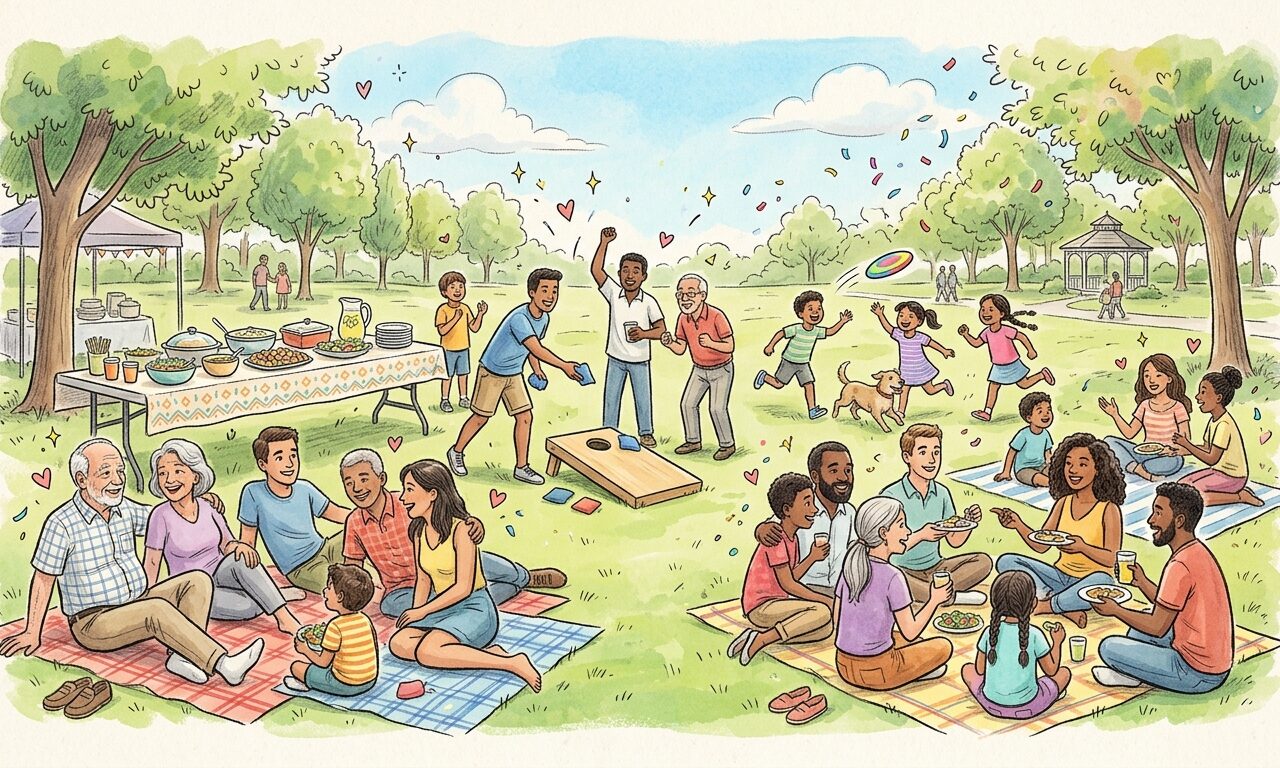
Family reunions are the kind of event that people talk about for years afterward. The stories, the games, the food, the moment Uncle Ray tried to start a talent show that no one asked for but everyone secretly loved.
They’re also the kind of event that falls apart when no one takes ownership of the planning. This guide covers how to plan a family reunion from scratch — ideas for activities, food, venues, and logistics — so you can pull off the kind of gathering people actually show up for.
Key Takeaways
- One person (or a small committee) needs to own the planning — family reunions don’t plan themselves
- Start planning 3–6 months in advance — especially for multi-day or destination reunions
- Activities that span generations are the secret to reunions everyone enjoys — not just the kids, not just the adults
- Food is a centerpiece — plan for diversity, volume, and dietary needs across all ages
Family Reunion Ideas: Formats That Work
Family reunions come in a lot of shapes. Here are the most common formats and when each one makes sense.
Backyard or park reunion. The most accessible format. Pick a large backyard, a park pavilion, or a community space. Works for 20–80 people. Lower cost, easy to customize, and familiar enough that no one feels displaced. Great for annual reunions or first-time organizers.
Cabin or campground weekend. Rent a large cabin, a group campsite, or a retreat center. Multi-day format allows for deeper connection — morning coffee conversations, evening campfires, spontaneous card games at midnight. Best for families who want more than a few hours together. Book 4–6 months in advance for summer weekends.
Beach or lake gathering. Natural swimming, outdoor games, easy food — the location does a lot of the work. Rent a beach pavilion or a lakeside property. Summer reunions at water are hard to beat.
Destination reunion. Some families do a full vacation together — a rental house in the mountains, a beach town, or a resort. More expensive and harder to coordinate, but deeply memorable for the people who can attend.
Restaurant or venue rental. Book a private room at a restaurant, a community center, or an event venue. Works well for urban families or smaller groups. Lower DIY effort, but higher cost per person and less flexibility for activities.
Family Reunion Activities for All Ages
The best family reunion activities work across generations. You need things kids love, things adults enjoy, and overlap in the middle where magic happens.
Games and Activities
- Backyard Olympics. Set up stations — cornhole, bocce, sack race, water balloon toss, three-legged race — and keep score. Divide into mixed-age teams so kids and grandparents are on the same side.
- Family trivia. Write questions about your family history, traditions, funny moments, and facts about family members. This is almost always the highlight of the reunion — people love learning things they didn’t know.
- Photo scavenger hunt. Give teams a list of photos to capture — “three generations together,” “a sibling hug,” “someone doing their best dad impression.” Gets people moving and laughing.
- Talent show or open mic. Completely optional participation. But the 10-year-old who does a magic trick and the grandpa who sings a song from 1962 are exactly the moments families retell for decades.
- Storytelling circle. Sit in a circle and ask an elder to share a memory. Then pass it around — each person shares one family memory. Simple, powerful, and the best use of 30 minutes at any reunion.
For more ideas that work across mixed ages and group sizes, the party games for adults guide has options that can be adapted for family settings.
Food Ideas for a Family Reunion
Family reunion food should be abundant, diverse, and low-fuss. Here’s what works:
- Potluck by family branch. Assign dishes by family group — Aunt Sandra’s crew brings desserts, the West Coast cousins bring a salad, grandma brings her famous recipe. It distributes work and creates pride in contribution.
- Catered BBQ. Hire a BBQ caterer or rent an industrial grill. Pulled pork, brisket, mac and cheese, coleslaw — classic crowd food that feeds 50 people without breaking a sweat.
- Family recipe competition. Ask family members to submit their “best” version of a classic dish — chili, cornbread, potato salad — and vote on the winner. The competitive element makes it fun.
Whatever you plan, have clear options for dietary restrictions. Vegetarian, gluten-free, and allergen-safe dishes need to be clearly labeled. The dietary needs guide at party.pro covers how to handle this without it feeling like an afterthought.
How to Plan a Family Reunion Step by Step
Family reunions don’t plan themselves. Someone has to own each piece. Here’s a clean process that works.
Step 1: Form a small planning committee. Two to four people maximum — one decision-maker and a few helpers. More than that and every decision takes a week of texts. Assign a lead planner who can make the final call when opinions diverge.
Step 2: Set the date and location. Pick a date range that works for the most important family members — usually the ones who have to travel the farthest. Send a simple poll if needed. Book the venue before you announce anything else.
Step 3: Build and manage the guest list. Family reunions often have complex guest lists — multiple branches, step-families, plus-ones, kids. Start with the core family tree and expand from there. The guest list management guide has a framework for keeping track of large groups without a spreadsheet crisis.
Step 4: Send invitations early. For a summer reunion, invitations should go out 3–4 months in advance. Use Mixily’s RSVP tool to send invitations and track responses in one place — especially helpful when you’re managing 40+ people across different contact preferences.
Step 5: Delegate tasks. Food, activities, decorations, day-of coordination — assign these to specific people early. Family reunions fail when one person tries to do everything. Use a shared checklist so everyone knows their job.
Step 6: Send reminders. Large family gatherings have a lot of moving parts. A reminder 1 week out and 2 days before the event keeps attendance solid and prevents last-minute chaos. Use automated reminder messages so you’re not manually texting 40 family members.
Build in unstructured time — 30–60 minutes where there’s nothing planned and people just talk, eat, and wander. The best moments at family reunions happen in the margins.
Over-program the day. A packed schedule with activities every 20 minutes leaves no room for the organic conversations and spontaneous moments that make reunions memorable.
Family Reunion Planning Timeline
Here’s a timeline for a summer family reunion, working backward from the event date.
- 6 months out: Decide on format and location. Book the venue.
- 4–5 months out: Send save-the-dates. Assign planning committee roles.
- 3 months out: Send formal invitations with RSVP deadline. Begin activity planning.
- 2 months out: Collect RSVPs. Plan food assignments. Book any catering or rentals.
- 1 month out: Finalize headcount. Purchase supplies. Create the day-of schedule.
- 1 week out: Send reminder. Confirm all assignments. Prepare any printed materials (name tags, activity sheets).
- Day before: Set up what you can. Prep food that can be made ahead. Review the day-of checklist.
For a complete party planning checklist that works for large events, the how to plan a party guide has a downloadable-style framework worth adapting for your reunion.
Make It a Reunion Worth Showing Up For
The family reunion everyone remembers isn’t the one with the biggest spread or the nicest venue. It’s the one where people actually connected — where cousins who hadn’t seen each other in a decade laughed for three hours, where the elder shared a story no one had heard before, where someone said “we have to do this every year.”
Plan it thoughtfully, delegate early, and build in room for the spontaneous moments. That’s the formula.
Ready to send the invitations? Create your free family reunion event page on Mixily — manage RSVPs, share details, and send reminders all in one place.
Related reading: Guest List Management | RSVP Response Examples | Outdoor Party Planning | How to Plan a Party