The One-Time Party Trap: Recurring Event Planning
I’ve seen it happen a hundred times — and recurring event planning is at the heart of it
Someone throws their first party. It goes great. People have fun. New connections are made. The host feels amazing. Then three months go by. Six months. A year. They never host again.
All those new connections? They fade. The momentum disappears. The relationships that could have grown stay exactly where they were — surface-level, full of potential, but going nowhere.
Here’s the thing I’ve learned after hosting hundreds of gatherings: one party is nice. But recurring events are where the magic actually happens. A single party introduces people. A series of parties turns acquaintances into friends.
If you’ve hosted even one event that went well, you already have the hardest part behind you. Now the question is: are you going to do it again?
Why Recurring Events Build Real Relationships
Think about the people you’re closest to in life. Your best friends. Your most trusted colleagues. The people you call when something big happens.
You didn’t build those relationships in a single interaction. You built them over time, through repeated contact. Researchers call this the “mere exposure effect” — we tend to like people more the more we see them. It’s not complicated. Familiarity breeds comfort, and comfort breeds real connection.
Hosting recurring events puts this psychology to work for you. Here’s what happens:
First Event: The Introduction
People meet each other. There’s curiosity and newness. Everyone’s on their best behavior. A few interesting conversations happen, but most connections stay light.
Second Event: The Recognition
“Oh hey, I remember you from last time!” Now there’s a foundation. People pick up where they left off. Conversations go deeper because the ice was already broken.
Third Event: The Belonging
By the third gathering, something shifts. People start to feel like they’re part of something. They bring friends. They ask when the next one is before the current one ends. You’ve created a community.
Fourth Event and Beyond: The Magic
This is where the real relationships form. People exchange numbers. They make plans outside of your events. They introduce each other to opportunities. Someone gets a job lead. Someone finds a business partner. Someone makes a genuine friend.
None of that happens from one party. It happens from showing up again and again.
The Compounding Effect
Hosting recurring events creates a compounding effect that benefits everyone — especially you.
Your Guest List Grows Automatically
After each event, your pool of potential guests gets bigger. People bring friends. Those friends bring friends to the next one. Within a few events, you’ll have more people wanting to attend than you can fit in your living room. That’s a great problem to have.
Your Reputation Builds
When you host consistently, people start to see you differently. You become “the person who brings people together.” That’s an incredibly valuable reputation in any social or professional circle. Opportunities come to connectors — always.
I’ve seen this happen with hosts in cities all over the world. They start by nervously inviting fifteen people to their apartment. A year later, they have a waiting list for their events and a network that most people would spend a decade trying to build.
It Gets Easier Every Time
Your first party takes the most effort because everything is new. You’re figuring out the format, the food, the timing. By your third or fourth event, you’ve got a system. You know what snacks to buy. You know which icebreakers work. You know that your friend Marcus will always show up early and help set up (and that your friend Lisa will text “running 10 min late” exactly 10 minutes before it starts, every single time).
The operational side becomes almost automatic, which frees you up to focus on what matters: the people.
How to Pick Your Recurring Format
Not every recurring event has to look the same. The best format is one that fits your life, your energy level, and your community. Here are some that work well:
Monthly Cocktail Party
The classic. A two-hour gathering on a weeknight, once a month. Drinks, snacks, name tags, and icebreakers. Simple. Effective. Endlessly repeatable.
Best for: People who want to build a broad social network and don’t mind hosting at home.
Biweekly Dinner Club
A small group (6–10 people) that meets every two weeks for dinner. Rotate who hosts or who picks the restaurant. The consistent cadence keeps the group tight.
Best for: People who prefer deeper connections with a smaller group.
Monthly Book Club or Discussion Group
Pick a book, a podcast, or a topic. Meet once a month to discuss it. The shared content gives everyone something to talk about, which takes the pressure off the host to “entertain.”
Best for: Introverts and people who prefer structured conversation.
Quarterly Big Gathering
If monthly feels like too much, try quarterly. Four events per year is enough to maintain momentum while giving you plenty of time to plan each one.
Best for: Busy professionals or people who want to host larger events.
Weekly Coffee or Walk
Not everything needs to be a party. A weekly coffee meetup at a local café or a regular Saturday morning walk with a rotating group can build community just as effectively. Need more inspiration? Browse these community event ideas for formats that keep people coming back.
Best for: People who prefer casual, low-effort connection.
Making It Sustainable
The number one reason people stop hosting recurring events? They burn out. They overcommit, over-prepare, or treat every event like it needs to be a production.
Here’s how to avoid that:
Keep It Simple
Every. Single. Time. Don’t escalate. If your first event was chips, drinks, and good conversation, your fifth event should be chips, drinks, and good conversation. Your guests aren’t coming for a culinary experience. They’re coming for the people.
Batch Your Planning
Set all your dates for the next six months at once. Create a template for your invitation messages. Buy the same snacks every time. The less you have to think about logistics, the more likely you are to keep going. Building in hosting accountability — like pre-setting your dates — makes it much harder to let the habit slip.
Delegate
You don’t have to do everything alone. Ask a friend to bring ice. Ask someone else to help with introductions. If you have a co-host, even better — split the work and share the fun.
Give Yourself Permission to Skip One
Life happens. If you need to cancel an event, cancel it. Send a quick message: “Hey everyone, taking a break this month. See you in April!” Nobody will hold it against you. What matters is that you come back.
Don’t Chase Perfection
Your event doesn’t need to be perfect. The name tags can be crooked. The wine can be cheap. Someone might arrive before you’ve finished putting out the crackers. None of that matters. What matters is that people are in a room together, talking and laughing.
The bar for a great recurring event is this: did people have a good time and do they want to come back? That’s it.
How to Get Started
If you’ve never hosted a recurring event, here’s your game plan:
Step 1: Pick Your Format
Choose one format from the list above that fits your life. Don’t overthink it. This guide on how to host breaks down the basics if you need a starting point. You can always change later.
Step 2: Set Your First Three Dates
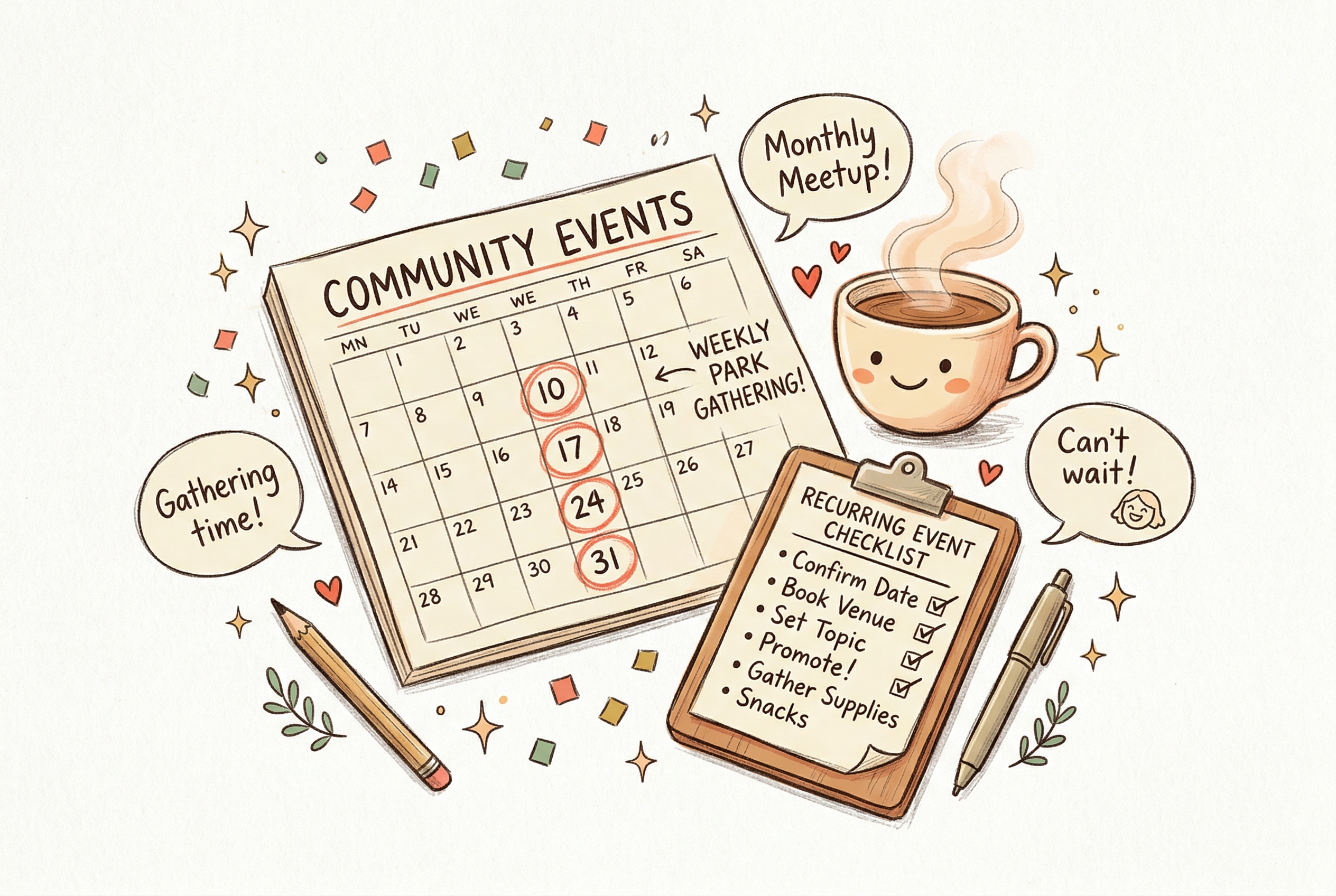
Put them on the calendar right now. Spacing them four to six weeks apart gives you breathing room. Having three dates set signals to your guests (and yourself) that this is a real, ongoing thing — not just a one-off.
Step 3: Invite Your Core Group
Start with five to ten people you know will show up and set a great tone. Get their confirmations first. Then widen your invite list.
Step 4: Create a Simple Event Page
Use a free RSVP tool to set up your event. Include the date, time, location, and a short description. Share the link. Make it easy for people to say yes with one click.
Step 5: After the First Event, Commit to the Second
The first event will go well. You’ll feel great. Ride that momentum. Send the invitation for the second event within a week. Don’t let the gap stretch too long, or inertia wins.
Step 6: Build the Rhythm
By the third event, you’ll have a system. By the fifth, you’ll have a community. By the tenth, you’ll wonder how you ever lived without it.
Start Building Something That Lasts
One party is a nice evening. A series of parties is a life-changing habit.
The people who host recurring events don’t just have more friends — they have richer, more connected lives. They’re the ones who get invited to things, who hear about opportunities first, and who have a community they can lean on when things get hard.
You don’t need a big house, a big budget, or a big personality to pull this off. You just need to keep showing up. Keep opening your door. Keep bringing people together.
The compound interest on human connection is the best investment you’ll ever make.
So set your dates, send your invites, and start building something that lasts.
Ready to make hosting recurring events easy? Create your free event series on Mixily — set up your next gathering, track RSVPs, and keep your community coming back.
Related reading: Building Community Through Regular Events | How to Get People to Actually RSVP | how to plan a party | game night ideas